
This introductory-to-intermediate course is tailored for frontline professionals who need to develop or refresh their cardiac monitoring skills:
 Medical Students preparing for clinical placements, OSCEs, or acute care rotations.Nursing Students & Registered Nurses looking to master cardiac monitoring and baseline rhythm assessment.Junior Doctors working across emergency departments, acute medicine, cardiology, or general wards.Physician Associates & Allied Health Professionals supporting acute patient triage and diagnostic assessments.Clinicians preparing for simulation-based training or seeking a high-yield refresher.Flexible E-Learning: Self-paced remote learning featuring interactive case studies and guided expert explanations designed to fit around your shift patterns.Face-to-Face Teaching: High-impact, classroom-based workshops featuring facilitated group discussions, practical case applications, and clinician-led teaching.
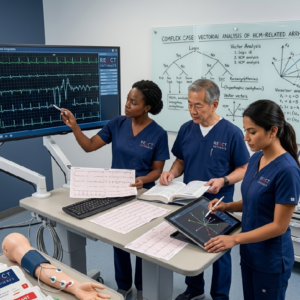 Structured 10-Point Analysis: Build an unshakeable system covering rate, rhythm, P-waves, PR-interval, QRS complex, ST-segment, T-waves, and the QT-interval.Real-World Pattern Recognition: Learn to confidently identify critical abnormalities, including Atrial Fibrillation, STEMI, bundle branch blocks, VT/VF, and heart blocks.Artefact Elimination: Master 12-lead placement, electrode positioning, and patient preparation techniques to eliminate misleading technical errors.
By the end of this module, you will be able to:
Map the correlation between the cardiac conduction system (SA node, AV node, Purkinje fibres) and standard ECG waveforms.Apply a systematic methodology to analyse any 12-lead ECG trace without missing subtle pathologies.Synthesise ECG findings with a patient’s history, presenting symptoms, and clinical picture to drive safe intervention.