Course Overview Master the complex clinical, legal, and ethical intersections that define acute end-of-life care. Palliative Emergencies in the Emergency
Course Overview Master the critical, time-sensitive clinical challenges that define modern paediatric safeguarding. Non-Accidental Injury (NAI) in Children is a
Course Overview Introduce alcohol withdrawal as a common and potentially life-threatening Emergency Medicine presentation requiring early recognition, structured risk assessment,
Course Overview Venepuncture is one of the most frequently performed invasive clinical procedures in healthcare, yet its impact on patient
Course Overview In the high-stress environment of major trauma resuscitation, clinical expertise alone is not enough; survival depends on flawless
Course Overview A suspected or confirmed poisoning is a high-stakes, time-sensitive medical emergency where early, decisive intervention drastically reduces the
Course Overview Syncope accounts for a significant portion of emergency presentations and acute admissions, yet identifying its root cause can
Course Overview Neurological emergencies demand immediate, highly coordinated action to minimise permanent tissue damage and loss of function. This course
Course Overview Shock is a life-threatening state of circulatory collapse where inadequate tissue perfusion rapidly starves vital organs of oxygen.
Course Overview Sepsis is a medical emergency where seconds count. This structured module provides a definitive guide to the early
Course Overview In the high-pressure environment of urgent and emergency care, safeguarding vulnerabilities are frequentlymasked by acute medical crises. This
Course Overview Patient collapse is rarely sudden; it is almost always preceded by gradual, subtle changes in physiological signs, appearance,
Course Overview Achieving a Return of Spontaneous Circulation (ROSC) is not the finish line—it is the start of a highly
Course Overview Sepsis remains one of the leading causes of avoidable death in children worldwide. Because its early presentation often
Course Overview Because of distinct anatomical and physiological differences—such as smaller airways, higher baseline metabolic demands, and minimal physiological reserves—respiratory
Course Overview Fever is one of the most common presentations in paediatric medicine—frequently benign, yet occasionally the sole early marker
Course Overview In paediatric care, a child’s clinical condition can deteriorate with devastating speed. The Paediatric Assessment Triangle (PAT) module
Course Overview In patients with suppressed immune systems, an infection isn’t just an illness—it is a catastrophic, time-critical oncology emergency.
Course Overview When a major trauma patient arrives, the clinical environment becomes high-pressure and chaotic. Survival depends entirely on a
Course Overview In modern acute medicine, waiting hours for a formal radiology report can compromise patient care. Frontline clinicians need
Course Overview Hyperkalaemia is a silent, rapid killer capable of causing fatal cardiac arrhythmias with little to no warning. This
Course Overview Hyponatremia is one of the most common—yet poorly understood—electrolyte imbalances encountered in acute hospital settings. Managing it incorrectly
Course Overview In acute and emergency care environments, a head injury can evolve from a seemingly minor incident into a
Course Overview Even the most technically gifted clinicians can experience failure in a resuscitation attempt if team dynamics break down.
Course Overview A major gastrointestinal bleed is a true medical emergency that can rapidly escalate from occult blood loss to
Course Overview Frailty is not an inevitable consequence of aging; it is a distinct, measurable medical syndrome characterised by depleted
Course Overview A fall in an older adult is rarely just an isolated accident; it is frequently the primary indicator
Course Overview Providing high-quality end-of-life care within the high-pressure environment of an Emergency Department is one of the most profound
Course Overview In acute care, electrolyte imbalances are silent accelerators of critical decline. This comprehensive module provides healthcare professionals with
Course Overview The electrocardiogram is one of the most powerful diagnostic tools in medicine, yet interpretation errors remain a frequent
Course Overview Domestic abuse is often a hidden epidemic, with many victims passing through healthcare settings undetected. The Domestic Violence
Course Overview Delirium is a acute medical emergency that frequently goes unrecognized in inpatient settings. The Delirium Assessment and Management
Course Overview When a patient presents with chest pain, every second counts. The Chest Pain and ACS module delivers a
Course Overview In trauma medicine, protecting the cervical spine is paramount to preventing catastrophic neurological damage. The Cervical Spine Assessment
Course Overview Urinary catheterisation requires a careful balance of anatomical precision, strict infection prevention, and absolute patient dignity. The Urinary
Course Overview Providing a dignified, peaceful death is one of the most profound duties in medicine. The Care of the
Course Overview In the high-pressure environment of a cardiac arrest, structured execution saves lives. The Cardiac Arrest Algorithms (ALS Focused)
Course Overview Intravenous access is one of the most frequently performed—yet highly variable—clinical procedures. The Cannulation: Standard and Difficult Access
Course Overview Laboratory data is a window into a patient’s physiological state—but only if you know how to read between
Course Overview Mastering electrocardiography is one of the most critical skills in acute medicine. The ECG Interpretation course bridges the
Course Overview The first and most critical rule of patient survival across any medical specialty is simple: protect the airway.
Course Overview When a patient experiences cardiac arrest, structured, immediate action is the only thing that stands between life and
Course Overview The Acute Respiratory Failure module provides learners with a clear understanding of how to recognise, assess, and manage
Course Overview This module provides a comprehensive introduction to the recognition, assessment, and early management of acute surgical presentations in
Course Overview The Acute Patient Assessment module provides learners with a comprehensive understanding of how to assess, monitor, and manage
Course Overview This module introduces acute oncology emergencies, focusing on how healthcare professionals recognise, assess, and respond to urgent complications
Course Overview This module provides a comprehensive introduction to the recognition, assessment, and early management of Acute Kidney Injury (AKI)
Course Overview An arterial blood gas result is only as reliable as the sample collected. This masterclass offers a seamless,
Course Overview Mastering Arterial Blood Gas (ABG) analysis is one of the most critical skills in acute, emergency, and intensive
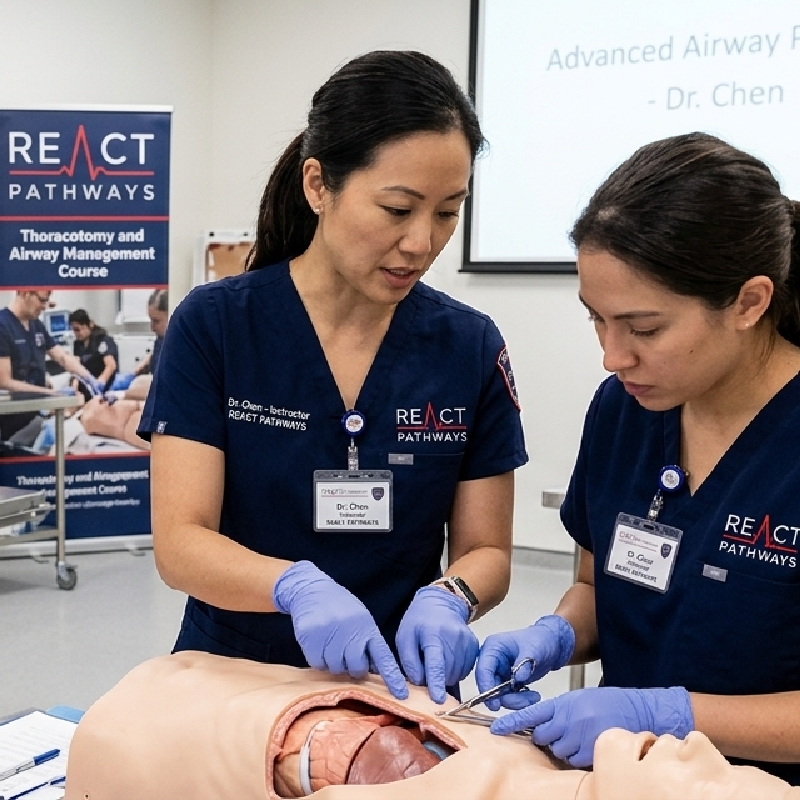
Course Overview Thoracotomy and airway course focuses on high-acuity interventions that are rarely performed but may be life-saving in extreme