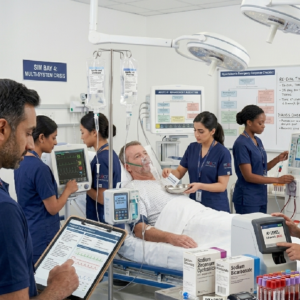
Perfect for any healthcare learner or practicing professional who manages acute or transitioning inpatients:
 Medical & Nursing Students learning the critical pillars of acute fluid and renal medicine.Junior Doctors & Foundation Trainees responsible for interpreting urgent blood results on the wards.Emergency Medicine & Critical Care Clinicians executing rapid, life-saving metabolic interventions.Renal Medicine Specialists & Inpatient Ward Nurses managing complex chronic or acute kidney injuries.Frontline Clinicians looking to dramatically increase their confidence when handling critical lab alerts.Flexible E-learning: Self-paced remote learning featuring highly interactive clinical cases, algorithmic decision trees, and expert-guided explanations.Face-to-Face Teaching: High-energy, classroom-based workshops utilising facilitated peer discussions, real-world case applications, and clinician-led teaching.
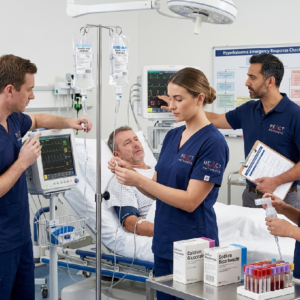 Comprehensive review of renal physiology and potassium homeostasis.Advanced ECG interpretation masterclass focusing specifically on hyperkalaemic morphology.Structured protocols detailing immediate myocardial stabilisation and cellular potassium shifting.Safe practice guides for medication reviews, fluid optimisation, and electrolyte monitoring.
By the end of this module, you will be able to:
Interpret and Act: Confidently evaluate urgent blood results alongside clinical symptoms to gauge hyperkalemia severity.Execute ECG Analysis: Instantly identify hyperkalemia-associated ECG changes before lethal arrhythmias occur.Deploy Safe Emergency Therapy: Administer the three pillars of hyperkalemia care: stabilise the heart, shift potassium, and remove excess potassium from the body.Escalate Appropriately: Identify clear clinical thresholds for specialist escalation or urgent renal replacement therapy (dialysis).