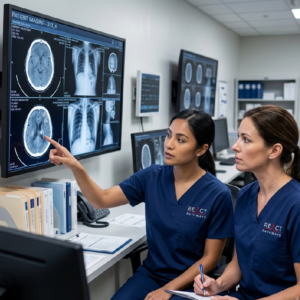

This course is customised for healthcare learners and clinicians whose diagnostic decisions rely heavily on rapid imaging:
 Medical Students looking to build a bulletproof foundation in radiology fundamentals.Junior Doctors & Foundation Trainees interpreting out-of-hours emergency scans.Physician Associates & Acute Care Nurses looking to correlate imaging findings with clinical status.Radiology Learners & Trainees seeking a highly structured approach to image analysis.Emergency and Hospital Clinicians wanting to boost their confidence in CT, MRI, and Ultrasound interpretation.Flexible E-learning: Self-paced remote learning featuring highly interactive clinical cases, algorithmic decision trees, and expert-guided explanations.Face-to-Face Teaching: High-energy, classroom-based workshops utilising facilitated peer discussions, real-world case applications, and clinician-led teaching.
 Interactive scan-viewing software covering CT orientation, tissue densities, and artifact identification.Comprehensive breakdowns of MRI sequencing, contrast applications, and detailed soft tissue assessments.Ultrasound essentials covering echogenicity, dynamic imaging, and real-time Doppler applications.Curated library highlighting the most common interpretation mistakes and subtle pitfalls made by clinicians.
By the end of this module, you will be able to:
Apply Structured Frameworks: Utilise methodical frameworks to evaluate scan quality, verify orientation, and analyse anatomy systematically.Spot Acute CT Pathologies: Identify intracranial haemorrhage, acute ischemic stroke, hydrocephalus, bone fractures, and mass effect.Correlate Clinically: Perfectly match radiological findings with the patient's physical presentation to guide safe management.Recognise Urgent Findings: Isolate immediate radiology red flags that demand instant specialist neurosurgical or surgical intervention.