Artificial intelligence (AI) is no longer a future concept in healthcare.
It is already here.
From clinical documentation and medical imaging to healthcare education, workforce planning, research, and patient communication, AI is rapidly becoming part of everyday healthcare practice. Yet despite the growing conversation surrounding AI, many healthcare professionals remain uncertain about what it actually means for them, their patients, and the future of healthcare delivery.
Some see AI as a revolutionary opportunity. Others view it with caution, concerned about safety, ethics, governance, and the potential impact on professional roles.
Both perspectives are valid.
The most important question is no longer whether AI will influence healthcare.
It is how we choose to use it.
What Is Artificial Intelligence?
Artificial intelligence refers to computer systems designed to perform tasks that traditionally require human intelligence. These tasks may include recognising patterns, analysing information, generating content, solving problems, making predictions, or supporting decision-making.
Healthcare professionals already interact with AI more frequently.
Examples include:
- Clinical decision support systems
- Medical imaging analysis
- Predictive risk models
- Speech recognition software
- Automated appointment systems
- Virtual assistants
- Generative AI tools such as ChatGPT, Copilot, Gemini, Claude, and emerging healthcare-specific platforms
AI is not a single technology. Rather, it is a collection of tools that can augment human capabilities.
The keyword is augment.
AI should be viewed as a support tool rather than a replacement for clinical expertise.
Why Is AI Receiving So Much Attention?
Healthcare systems across the world face similar challenges:
- Increasing patient demand
- Workforce shortages
- Administrative burden
- Rising healthcare costs
- Growing complexity of care
- Educational pressures
- Information overload
At the same time, clinicians spend significant amounts of time on activities that do not directly involve patient care.
Documentation, administration, information retrieval, educational preparation, audit work, policy development, and communication all consume valuable time.
AI has the potential to reduce some of this burden.
The greatest opportunity may not be that AI is more intelligent than clinicians.
It is that AI can help clinicians spend more time being clinicians.
Understanding the Three Levels of AI in Healthcare
One of the simplest ways to understand AI is to view it through three practical levels.
Level 1: AI as an Assistant
This is where most healthcare professionals first encounter AI.
AI can assist with:
- Drafting emails and reports
- Creating meeting summaries
- Generating educational materials
- Organising information
- Supporting documentation workflows
At this level, AI functions much like a highly capable administrative assistant.
Level 2: AI as an Educator
Increasingly, AI is becoming a powerful learning companion.
In now a days healthcare professionals are using AI to:
- Explain complex concepts
- Create revision resources
- Generate practice questions
- Develop teaching sessions
- Build simulation scenarios
- Explore clinical guidelines
For many learners, AI is becoming a personalised tutor available at any time.
Level 3: AI as an Advisor
At its most advanced level, AI supports clinical reasoning and decision-making.
Examples include:
- Clinical decision help
- Diagnostic assistance
- Risk prediction
- Pattern recognition
- Resource planning
Importantly, AI may advise, but accountability remains with the healthcare professional.
Understanding these three levels helps clinicians recognise where AI can add value while maintaining appropriate professional responsibility.
A Day in the Life of a Future NHS Clinician
Imagine a clinician starting work in a future NHS environment.
Before the morning handover, AI summarises overnight events from multiple patient records.
During ward rounds, documentation is automatically drafted and ready for review.
When managing a complex patient, relevant guidelines, recent evidence, and local protocols are surfaced instantly.
At lunchtime, the clinician receives a personalised learning recommendation based on recent cases encountered in practice.
Later in the day, AI assists in creating teaching materials for students and trainees.
Before leaving work, routine administrative tasks that previously consumed hours have already been completed.
The clinician remains responsible for every decision.
The difference is that less time is spent searching, typing, and organising, and more time is spent thinking, communicating, teaching, and caring.
This is perhaps the most realistic vision of AI in healthcare—not replacement, but augmentation.
Where Is AI Already Being Used in Healthcare?
Clinical Documentation
One of the fastest-growing areas of AI adoption is documentation support.
AI-powered transcription and documentation tools can assist clinicians by generating consultation notes, discharge summaries, clinic letters, and meeting summaries.
While human review is still very essential, these tools can significantly reduce administrative workload and improve efficiency.
Medical Imaging and Diagnostics
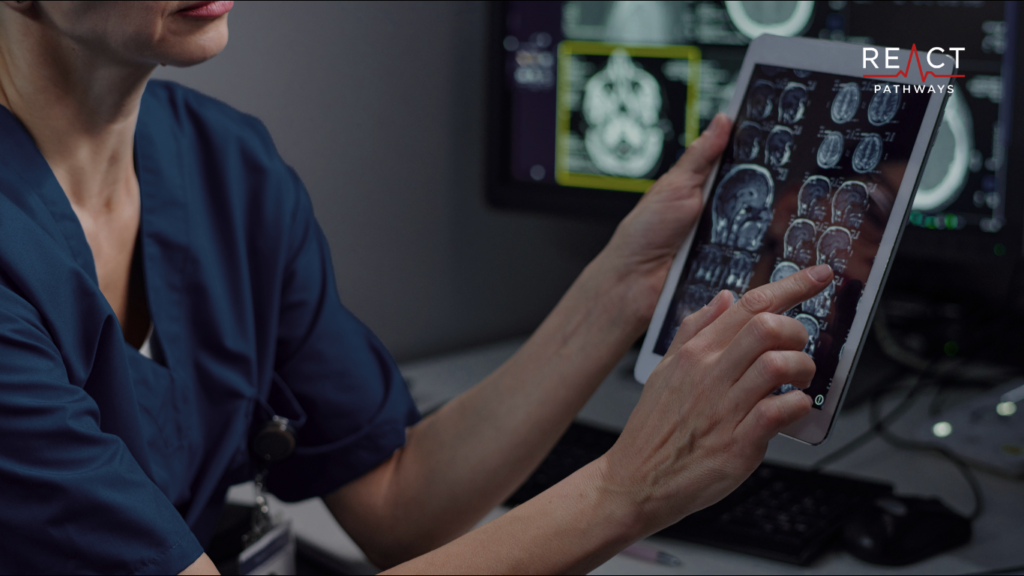
AI systems are increasingly being used to identify patterns within imaging studies such as X-rays, CT scans, MRI scans, and retinal images.
These tools can help clinicians by highlighting abnormalities, prioritising urgent cases, and improving workflow efficiency.
Importantly, AI supports rather than replaces clinical judgement.
Research and Innovation
Researchers are using AI to analyse large datasets, identify trends, generate hypotheses, accelerate literature reviews, and support scientific writing.
Tasks that previously required weeks of manual work can now be completed far more efficiently, allowing researchers to focus on interpretation and decision-making.
AI Will Change Healthcare Education Before It Changes Healthcare
Many people assume AI’s greatest impact will be on diagnosis and treatment.
Arguably, AI is already transforming healthcare education more rapidly than clinical practice itself.
In today’s era, educators can use AI to:
- Develop lesson plans
- Create OSCE stations
- Generate simulation scenarios
- Build assessment questions
- Produce learner feedback
- Design reflective exercises
- Personalise educational content
Learners can use AI to:
- Clarify difficult concepts
- Create revision resources
- Practise clinical conversations
- Explore case-based learning
- Receive immediate feedback
The challenge is no longer access to information.
The challenge is developing critical thinking skills that allow learners to evaluate information effectively.
In the age of AI, educational success will depend less on memorising information and more on understanding, applying, and questioning it.
AI Conversations: An Underrated Skill in Modern Healthcare
When people think about AI, they usually focus on technology.
In reality, one of the most important emerging skills is communication.
Modern AI systems operate through conversation.
The quality of the responding normally consist on the quality of the question.
For example:
Instead of asking:
“Tell me about sepsis.”
A clinician might ask:
“Explain sepsis to a newly qualified nurse working in an emergency department. Include red flags, escalation pathways, common pitfalls, and a patient scenario.”
The difference is substantial.
Effective AI conversations help users:
- Clarify thinking
- Structure ideas
- Solve problems
- Generate educational resources
- Explore different perspectives
- Improve decision-making processes
Learning how to communicate effectively with AI may become as important as literature searching, critical appraisal, and digital literacy.
The clinician who asks better questions will often receive better answers.
AI, Simulation and Immersive Learning
Perhaps one of the most exciting developments lies at the intersection of AI, simulation, and immersive learning.
Healthcare simulation has long provided safe environments for practising clinical skills, communication, leadership, and decision-making.
AI has the potential to make these experiences even more powerful.
Future applications may include:
- AI-generated simulation scenarios
- Dynamic virtual patients
- Real-time learner feedback
- Adaptive simulation pathways
- Personalised learning journeys
- Immersive virtual and mixed reality environments
Imagine a simulation patient who changes their behaviour based on learner decisions.
Imagine communication training where learners can practise difficult conversations repeatedly with realistic AI-powered patients.
Imagine simulation programmes that adapt to the learner’s strengths and weaknesses in real time.
These technologies are already beginning to emerge.
The future of healthcare education is unlikely to be purely digital or purely face-to-face.
It will be blended, immersive, adaptive, and increasingly intelligent.
The Risks and Limitations of AI
Despite its potential, AI is not without risk.
Healthcare professionals must remain aware of its limitations.
AI Can Be Wrong
AI systems can generate inaccurate information, sometimes with a high degree of confidence.
This is why verification and professional judgement remain essential.
Bias Can Exist
AI systems learn from existing data.
If that data contains bias, outputs may also reflect those biases.
Healthcare organisations must ensure AI is implemented responsibly and equitably.
Privacy and Governance Matter
Patient confidentiality remains paramount.
Healthcare professionals should always follow organisational policies, information governance standards, and regulatory guidance when using AI systems.
The question should never be:
“Can AI do this?”
The question should be:
“Should AI do this, and under what safeguards?”
The Future of AI in the NHS
The future of AI is unlikely to involve robots replacing doctors, nurses, or allied health professionals.
Instead, AI will increasingly become an invisible layer supporting healthcare systems in the background.
Future developments may include:
- Personalised education pathways
- Intelligent clinical decision support
- Automated administrative workflows
- Enhanced patient communication
- Predictive healthcare analytics
- AI-supported simulation and training
- More efficient healthcare operations
The organisations that succeed will not necessarily be those with the most advanced technology.
They will be the organisations that combine technology with strong governance, educational expertise, clinical leadership, and patient-centered values.
The REACT Pathways Perspective
At REACT Pathways, we view AI as an opportunity to enhance learning, support clinicians, and improve healthcare education.
Technology alone is never the solution.
Educational impact comes from combining innovation with evidence-based practice, simulation, human factors, educational science, and professional judgement.
Whether developing healthcare professionals, designing educational programs, delivering simulation training, or improving clinical workflows, the focus must remain on safe, effective, and human-centered practice.
The future of healthcare will undoubtedly involve AI.
The future of healthcare should also continue to involve compassion, communication, critical thinking, and professional judgement.
These remain uniquely human strengths.
The Real Question Isn’t Whether AI Will Replace Clinicians
Much of the public discussion surrounding AI focuses on replacement.
Will AI replace doctors?
Will AI replace nurses?
Will AI replace educators?
These are understandable questions.
But they may not be the right questions.
The real question is whether clinicians who understand AI will outperform clinicians who do not.
Not because AI is replacing healthcare professionals.
But because healthcare professionals who learn to work effectively alongside AI may become more efficient, more informed, more productive, and ultimately better equipped to navigate an increasingly complex healthcare environment.
Just as email replaced letters, electronic records replaced paper notes, and ultrasound became an extension of clinical assessment, AI is likely to become another everyday professional tool.
The future may not belong to those who resist AI.
Nor will it belong to those who adopt it uncritically.
It will belong to those who learn how to use it wisely.
Conclusion
Artificial intelligence is transforming healthcare at a remarkable pace.
Yet the most important lesson for healthcare professionals is surprisingly simple.
AI is not replacing clinical expertise.
It is becoming another tool within the professional toolkit.
Like any tool, its value depends on how it is used.