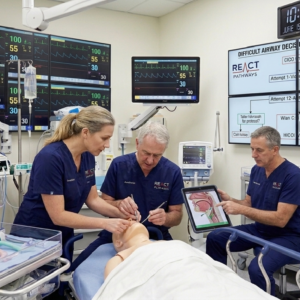
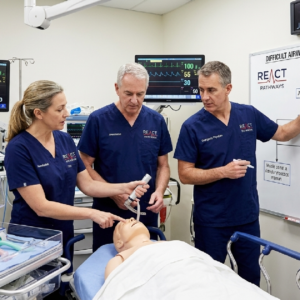
Essential for clinicians operating in high-stakes environments where urgent airway control may be required:
 Emergency Medicine, Anaesthetic, Intensive Care, and Trauma CliniciansQualified Nurses in Emergency Departments, Resuscitation areas, Theatres, and Intensive Care UnitsOperating Department Practitioners (ODPs), Anaesthetic Assistants, and Resuscitation TeamsParamedics, Retrieval Teams, and Transfer Practitioners managing out-of-hospital airwaysMedical Students and Junior Doctors seeking to understand airway risk stratification and escalation rulesClinical Educators and Governance Leads designing team training on difficult airway algorithmsFlexible E-Learning: Self-paced, remote digital learning featuring interactive clinical cases and step-by-step guided explanations.Face-to-Face Teaching: Dynamic, classroom-based workshops packed with facilitated peer discussions, practical case applications, and expert clinician-led teaching.
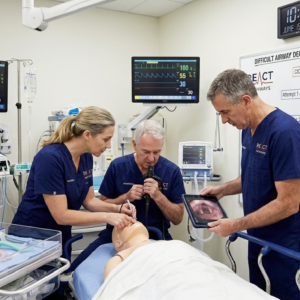 The Airway Vulnerability Matrix: Techniques to rapidly spot risk factors, from facial trauma to severe anatomical constraints.The Plan A/B/C/D Framework: Direct application of evidence-based airway guidelines to seamlessly pivot from primary plans to emergency rescues.Human Factors in Airway Crisis: Strategies to voice concerns, call for senior support early, and declare a "cannot intubate, cannot oxygenate" emergency without hesitation.Rescue Intervention Training: Theoretical and procedural positioning foundations for supraglottic devices and surgical airway access.
By the end of this module, you will be able to:
Conduct a proactive, rapid assessment to accurately identify and stratify difficult airway risks.Formulate comprehensive, multi-layered airway management strategies including primary and rescue pathways.Lead airway teams with crisp, clear communication, managing cognitive overload and defining attempt limits.Transition safely and seamlessly between airway algorithms when an intervention fails.Recognise and respond instantly to critical, life-threatening "cannot intubate, cannot oxygenate" scenarios.